
Your English Was Never Wrong
On prepone, good names, and two hundred years of fixing a language we were taught to feel like guests in.

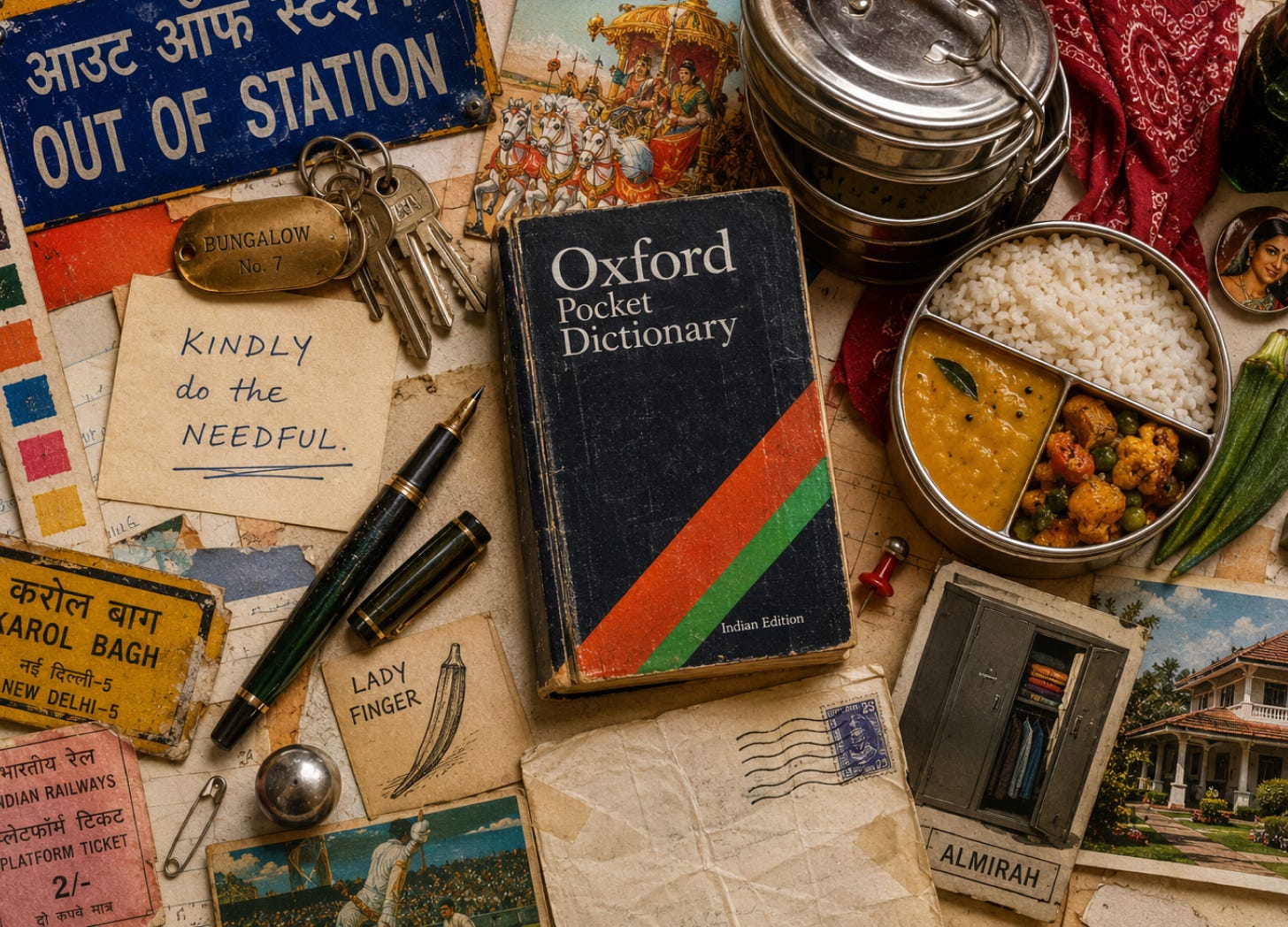
A colleague once told me that he had preponed our meeting from Thursday to Wednesday.
Something in me, the part that grew up being told what was correct, wanted to stop him. Prepone is not a word, I almost said. The word is reschedule. Or moved up. Or earlier.
And then I sat with it for a second, and I could not find anything wrong.
Postpone exists. To move something later. So why is there no word for moving something earlier? English, the language that has a word for the smell of rain and a word for the fear of long words, somehow never built the opposite of one of its most ordinary verbs.
We needed it. We made it.
English has holes in it. You have felt this recently even if you are not Indian.
If you are chronically online, you know the fight the internet has been having for a year about whether men should be nonchalant. Dating-app bios built around it. And somewhere underneath all that noise, a smaller problem nobody could solve: there is no opposite. You cannot be chalant. The word exists only in its own negation, which is a strange thing to build an entire personality ideal around.
English does this sometimes. It hands you a word and quietly keeps the other half.
So the question I want to ask is not why Indians speak English strangely. It is why we ever agreed that the holes were ours to apologise for.
Take the one everyone loves to laugh at. What is your good name?
It sounds, to an outsider, like a charming error. As though there might be a bad name you are keeping in reserve. But it is not an error. It is a translation, almost word for word, of shubh naam. The auspicious name.
It comes from a world where a name is not just a label. It is a blessing, the first auspicious thing your family gives you, chosen carefully, sometimes by a priest, sometimes by the stars. To ask for someone’s good name is to ask for the blessing they were given. English was too small to hold the idea, so it came out sounding quaint.
The pattern is everywhere once you see it. We say out of station, a phrase that has outlived the railways that made it. We ask people to do the needful, which is mocked endlessly and is, if you think about it, gloriously efficient. Do the thing that needs doing. You already know what it is. English would take a whole sentence to say what those three words say.
None of this is broken English. It is English made to think in another language, and bent, beautifully, to fit.
And once you notice we bend the words, you see that we do not stop at words. We build whole sign systems the rest of the world does not have.
Look at any packet of food in India. There is a small dot in a box. Green for vegetarian, red for not. A whole dietary universe compressed into a single coloured square, legible to a child, legible to someone who cannot read, legible across twenty languages at once.
The first time you buy food outside India you feel the absence of it like a missing step in a staircase. You turn the packet over looking for the dot, and there is no dot, and you realise you have spent your whole life reading a code you assumed was universal and was, in fact, ours.
I should admit something here, because the loop is too neat to ignore.
This publication is called Native Place. Which is, itself, one of the most Indian English phrases there is. What is your native place? It does not mean where do you live, or where you were born. It means where are you from, in the deep sense, the town your family belongs to, the place you would name even if you had never lived there a day. English never needed to ask the question the way we do.
Here is the part we forget most of all.
The borrowing has never gone only one way. English has been quietly eating our words for years and calling them its own.
When you read about an unstoppable force, a juggernaut, you are saying Jagannath, the deity whose chariot rolls through Puri. Loot is Hindi. So is jungle, and bungalow, and pyjama, and shampoo, and thug, and veranda, and pundit. You have been speaking Indian languages your whole life without noticing, because at some point those words stopped feeling foreign and simply became English.
Which is the whole point. That is how it always works.
More people use English in India than almost anywhere on earth. Not as a mother tongue, but as a language they live and work and argue in. We are not a dialect waiting at the edge of the language. We are, by the simple arithmetic of how many mouths shape it daily, one of its largest owners. Jamaican English is a language. British English is a language. The idea that ours is a charming deviation from the real thing, rather than a real thing in itself, is the last idea we are still waiting for permission to drop.
Every word that feels wrong today is a word that has not finished arriving yet. Loot was once exactly as foreign to an Englishman as prepone is now. The only difference between a charming Indianism and a respectable English word is time, and who is doing the laughing.
And it is not even an Indian story, in the end. It is just the most visible version of one happening everywhere.
The Spanish do not type haha. They type jaja. Indonesians laugh in wkwkwk. Thais in 555, because the number five is pronounced ha. And we have built a whole emoji grammar of our own. The folded hands that mean thank you and respect and please and sorry depending on the day. The good-morning messages thick with roses and bouquets. The single haanji with a thumbs up that closes a conversation more firmly than any full stop.
Nobody approved any of this. People just needed to say something the language could not yet say, and they built it, in real time, on their phones, the way humans have always built language, except now we get to watch it happen.
Language was never handed down from above. It was always made from below, by whoever was actually using it.
And the people who actually use it are starting to win.
Prepone now has an entry in Merriam-Webster’s Words We’re Watching, the list they keep of words they are seeing more and more but that have not yet, in their words, met the criteria for entry. Which is a wonderful thing to read, if you think about what it is. It is the keeper of the language standing at the window, watching a word we made walk slowly up the drive, deciding whether to let it in.
Another colleague in the US once told me, candidly and kindly, that our product demo videos came out much better when they were shot by someone there. He did not say my accent. He did not have to. He meant well, the way most people who say these things mean well, which is exactly what makes it so hard to be angry about. You just quietly hear yourself, and adjust, and make yourself a little less Indian, a little more acceptable, and tell yourself it is about the videos.
That reflex did not come from him. It came from much further back. We came into this language, we were not born into it, and some part of us has never stopped feeling like a guest in a house we have lived in for two hundred years, repainted, refurnished, and filled with our own words.
So we became the strictest guards at a gate that was never ours. The person most eager to correct your English is almost never English. It is one of us. We learned the hierarchy so well that we kept it long after the people who built it had gone home, wincing at our own words in our own mouths, mistaking our fluency for a kind of failure. You can own a thing completely and still flinch when you hear yourself in it. That flinch is the last colony, and it is the one we have to give up ourselves, because nobody is going to hand it back.
So here is the only correction I will make.
The next time someone tells you they have preponed the meeting, do not stop them.
PS. Kindly do the needful (like, share, and subscribe).
This was a wonderful read! I never though about 'good name' being a direct translation of 'shubh naam'.
The insecurity about getting our English right, in the way it should be as the English people speak it - whether in pronunciations or the usage of certain words- is a remnant of colonial shame. Like you said it, that flinch is the last colony. One we have to give up ourselves.
But it is a thing if we make it a thing. I have now been living in the US for a few years, and I have come to realize that nobody cares about your accent. Sometimes people might ask me to repeat a line if they didn't get it, just like I ask them to (because I have been so used to subtitles). We almost always have a good laugh about it. Besides there are people with thick accents who come from other parts of the world - east asian, east european. I haven't come across anyone who is as apologetic about their accent as we can be.
To your experience with the colleague- what if their concern was genuinely about the videos? Maybe the accent was only a part of the issue, if at all? Sometimes our insecurities make us less curious, because we assume that it is the whole of the problem :) . I could be totally wrong, but just food for thought.
The linguist John McWhorter says something to the effect of "dialects are all there is", and I think that's a useful way to frame what you're talking about. There is no such thing as "the English language", just a collection of more-or-less related dialects of English. The one spoken where I grew up in Scotland is one, the ones used in various parts of India are others.
The difference between them is political - "a language is a dialect with an army and navy".